
Category: Blog Post
-

Openlab Intern 2015 Experience
Openlab Intern 2015 Experience Sneak peek into the life as a CERN Openlab Summer Student It was a mix of bewilderment and awe when the first email came declaring that I was selected for the Openlab Summer Student Program. Little did I know that the journey would end in a mix of sadness (I never
-
How to create your own Oracle database merge patch
How to create your own Oracle database merge patch A little bit scary title, isn't it? Please keep in mind that definitely it is neither supported nor advised method to solve your problems and you should be really careful while doing it – hopefully not on production environment. But it may sometimes happen that you
-
Diagnose High-Latency I/O Operations Using SystemTap
Diagnose High-Latency I/O Operations Using SystemTap Topic: this post is about some simple tools and techniques that can be used to drill down high-latency I/O events using SystemTap probes. The problem: Operations with high latency on a filesystem and/or a storage volume can sometimes be attributed to just a few disks ‘misbehaving’, possibly because they
-
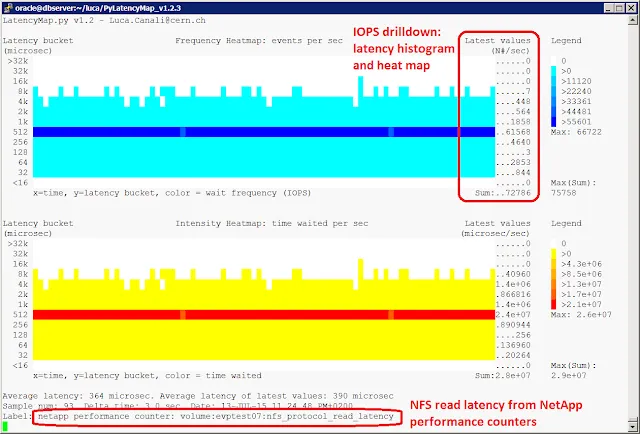
Heat Map Visualization of Latency Histograms for NetApp C-Mode
Heat Map Visualization of Latency Histograms for NetApp C-Mode Topic: This post is about collecting and visualizing I/O latency histograms for NetApp filers in C-mode. Motivations: The drill down of I/O latency is an important technique for troubleshooting and benchmarking storage. Average latency values can hide details of what is happening on the storage. Think
-
Oracle 12c – causing problem by solving it!?!
Oracle 12c – causing problem by solving it!?! Regular readers of our blog probably already know that for most of our databases we’re using two storage layers to keep our backups – NAS volumes as a primary layer and tapes as secondary one – please check “Datafile without backups – how to restore?” for more
-
Oracle Grid Infrastructure 12.1.0.2 – Hardening the MGMTDB Instance
Oracle Grid Infrastructure 12.1.0.2 – Hardening the MGMTDB Instance The Case Oracle Grid infrastructure 12c comes with GIMR – Grid Infrastructure Management Repository, aka MGMTDB. This is intended to help in troubleshooting clusterware issues and has become mandatory starting from version 12.1.0.2.The tiny database instance in question runs in single instance mode and is managed
-
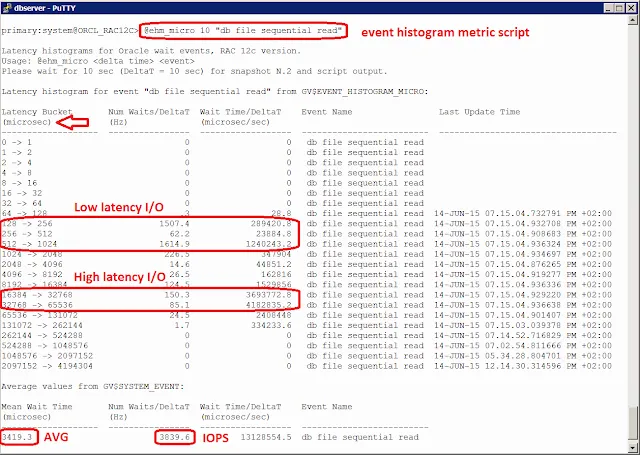
Event Histogram Metric and Oracle 12c
Event Histogram Metric and Oracle 12c Topic: event histogram metric, a script and some related discussions on collecting and displaying wait event latency histograms for Oracle performance troubleshooting. Also discussed is the new 12c feature of event histrograms with microsecond buckets. Why: Latency histograms (and by extension wait event histograms) provide very useful information when
-
CHEP 2015 papers on replication and scale-out databases
CHEP 2015 papers on replication and scale-out databases CHEP 2015, the 21st international conference on computing in high energy physics, has taken place in April 2015 in Okinawa, Japan. Here below you can find the links to the pdf of the talks, posters and related preprints of two of the contributions by members the CERN
-
Nuances of Oracle Managed Files (OMF) and RMAN
Nuances of Oracle Managed Files (OMF) and RMAN Oracle Managed Files (OMF) have many advantages, but the fact that such files could coexist in the same database with manually added (and named) ones, could sometimes lead to confusion. Situation is made worse by the fact, that there is no straightforward way (at least of which
-
Which shared memory segments belong to my database instance?
Which shared memory segments belong to my database instance? I’ve already described how important is to test your backup strategy and restore/recovery procedures, but while doing so, you could of course encounter some problems, not really related with the recoverability as such. Recently, we’ve got such a problem on our recovery server, at the very